
Skip to product information
1 of 3

U-ZEE Pro Dazzling Veneer Ceramic Blocks – No Crystallization Required

Veneer-focused direct-mill glass ceramic for selected thin and ultra-thin designs, featuring 280 MPa flexural strength, BL1–BL3 bleach shades, and no mandatory post-milling crystallization.

Regular price $79.00
Sale price $79.00 Regular price $89.00
Shipping calculated at checkout.
  • Designed for Anterior Veneer Workflows
  • Selected Veneer Designs from Approx. 0.3mm
  • No Mandatory Post-Milling Crystallization
  • BL1, BL2 & BL3 Bleach Shades
  • Lab support before ordering
  • Fast Mill → Polish → Finish Workflow

OnePro Dental U-ZEE Pro Dazzling Veneer Ceramic Blocks are direct-mill glass ceramic materials developed for professional dental laboratories and compatible chairside CAD/CAM workflows focused on anterior veneers, whitening veneers, and selected ultra-thin veneer designs.

With a flexural strength of 280 MPa, the material is positioned for esthetic anterior applications where a combination of thin restorative design, bleach-shade selection, workflow efficiency, and polished surface quality is required.

U-ZEE Pro Dazzling is available in BL1, BL2, and BL3 bleach shades. These three options allow laboratories to select different brightness levels according to the preparation color, veneer thickness, desired whitening effect, try-in procedure, and final bonding workflow.

After compatible wet milling, the veneer can proceed to careful removal, adjustment, polishing, and final inspection without a mandatory post-milling crystallization cycle. Selected veneer designs may begin from approximately 0.3mm where supported by the product instructions, case design, preparation, milling strategy, loading conditions, and professional assessment.

U-ZEE Pro Dazzling is supplied in the C14 block format, measuring 18 × 13 × 15mm, with 5 blocks per box. It is developed for anterior esthetic applications and is not intended for posterior, multi-unit, or high-load restorations.

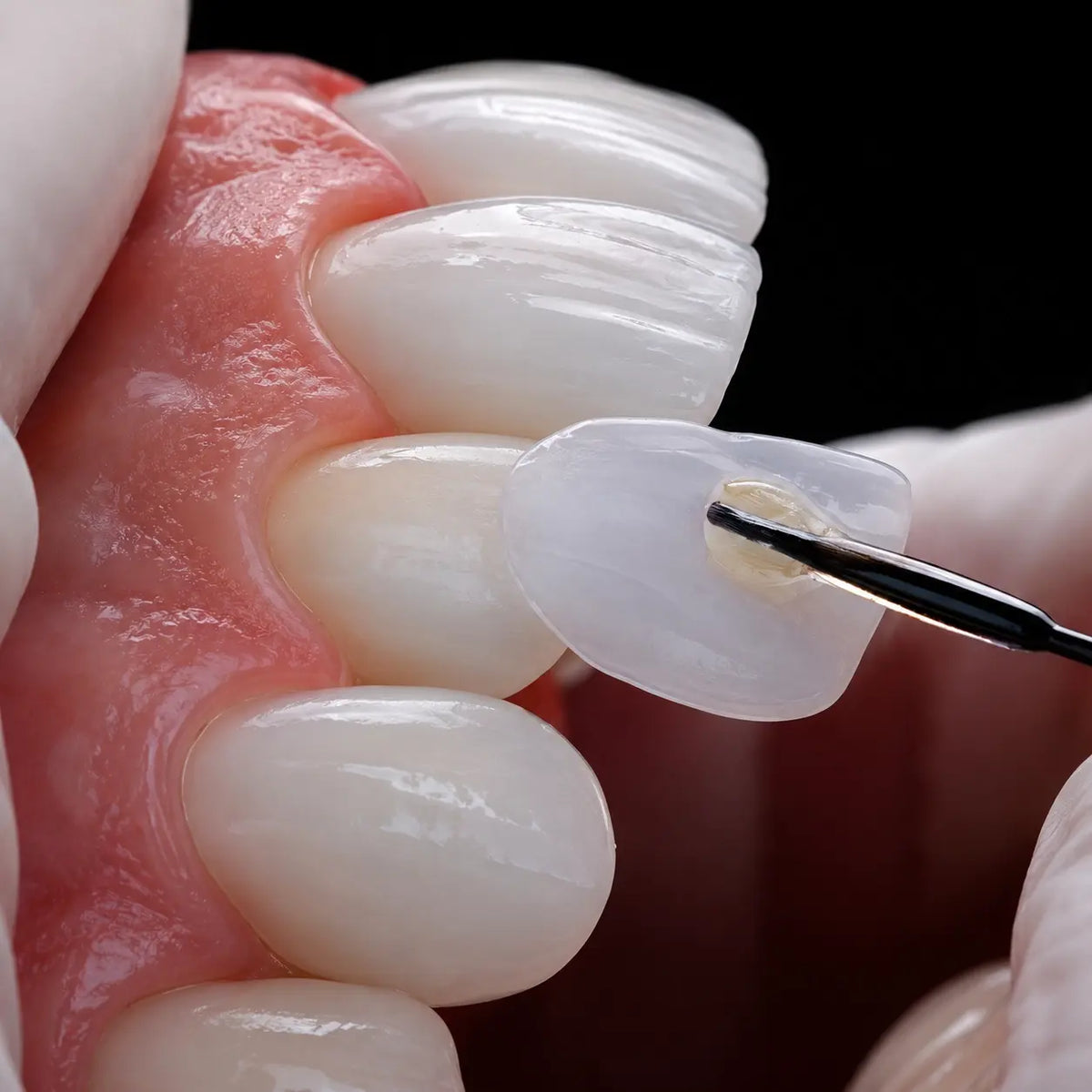
U-ZEE Pro Dazzling Veneer Ceramic displaying high translucency and a glossy natural-looking surface

Direct-Mill Glass Ceramic for Esthetic Veneer Workflows

A veneer-focused material developed for selected thin, ultra-thin, and whitening veneer applications.

OnePro Dental U-ZEE Pro Dazzling Veneer Ceramic Blocks are designed for professional dental laboratories and compatible chairside CAD/CAM users producing anterior esthetic veneers.

The product combines a direct-mill workflow with three dedicated bleach shades and a material specification of 280 MPa flexural strength. It is intended for cases where veneer esthetics, brightness, thin restorative design, and simplified post-milling processing are the primary considerations.

Unlike conventional lithium disilicate CAD/CAM blocks that require a mandatory crystallization cycle after milling, U-ZEE Pro Dazzling can proceed from compatible wet milling to careful adjustment, polishing, and final inspection.

The standard workflow is:
CAD Design → Wet Milling → Careful Removal → Adjustment → Polishing → Final Inspection

Selected veneer designs may begin from approximately 0.3mm where technically and clinically appropriate. Final thickness should always be determined according to the preparation, veneer design, material support, occlusion, milling accuracy, product instructions, and professional assessment.

Why Esthetic Labs Choose U-ZEE Pro Dazzling

A specialized direct-mill ceramic solution for laboratories producing bleach-shade, thin, and ultra-thin anterior veneers.

  • Veneer-Focused Design

    U-ZEE Pro Dazzling is specifically positioned for anterior veneer workflows rather than general posterior, bridge, or high-load restorative applications.

  • Selected Designs from Approx. 0.3mm

    The material can support selected veneer designs beginning from approximately 0.3mm where preparation, support, milling strategy, occlusion, and product instructions permit.

  • No Mandatory Crystallization

    The standard workflow does not require a mandatory post-milling crystallization cycle, helping reduce furnace dependency and simplify veneer production.

  • Dedicated Bleach Shades

    BL1, BL2, and BL3 provide three bleach-shade options for laboratories producing different levels of bright and whitening-oriented veneer results.

1 of 4
U-ZEE Pro ultra-thin veneer ceramic block with delicate veneer, handling instrument, and anterior veneer placement application

Designed for Selected Ultra-Thin Veneer Workflows

Thin and ultra-thin veneer production requires careful case selection, accurate CAD design, suitable material support, and controlled milling procedures.

U-ZEE Pro Dazzling can support selected veneer designs beginning from approximately 0.3mm. This does not mean that every veneer, every surface, or every case should be designed at a uniform 0.3mm thickness.

The final veneer thickness should be determined according to:

  • Preparation design and available restorative space
  • Remaining tooth structure and preparation color
  • Veneer shape and surface curvature
  • Incisal, marginal, and proximal design
  • Occlusal conditions and functional loading
  • Presence of bruxism or parafunctional habits
  • CAD design and nesting orientation
  • Milling-machine accuracy and tool condition
  • Support and attachment strategy
  • Handling, try-in, and bonding procedures
  • Applicable product and clinical instructions

Ultra-thin restorations require careful handling after milling. Excessive pressure during separation, adjustment, try-in, or polishing may damage thin margins or ceramic surfaces.

The 0.3mm specification should therefore be understood as a selected design capability rather than a universal minimum thickness recommendation for every veneer case.

Choose the Right Bleach Shade

Select BL1, BL2, or BL3 according to the desired brightness, preparation color, veneer thickness, and final bonding workflow.

  • BL1 – Highest-Brightness Option

    BL1 is the brightest option in the U-ZEE Pro Dazzling shade range.

    Consider BL1 when the treatment objective requires a pronounced bleach-shade appearance and the preparation, veneer thickness, try-in material, and bonding system support the desired final brightness.

  • BL2 – Balanced Bright-White Option

    BL2 provides a balanced bright-white base between BL1 and BL3.

    It can be considered when a strong whitening effect is required without selecting the highest-brightness option in the range.

  • BL3 – Softer Bleach Option

    BL3 provides a softer bleach-shade base than BL1 and BL2.

    It can be considered when the desired appearance requires a more restrained white tone while remaining within the dedicated bleach-shade range.

1 of 3

Recommended Applications & Case Boundaries

U-ZEE Pro Dazzling is a specialized anterior veneer material and should be selected according to the restoration design and functional requirements.

  • Recommended Applications

    • Anterior veneers
    • Whitening and bleach-shade veneers
    • Selected thin veneers
    • Selected ultra-thin veneers
    • Selected anterior esthetic restorations supported by the applicable product instructions

    Suitable for professional dental laboratory and compatible chairside CAD/CAM veneer workflows.

  • Not Intended For

    • Posterior crowns
    • Posterior onlays or high-load restorations
    • Multi-unit bridges
    • Long-span restorations
    • High-stress functional applications
    • Severe bruxism or parafunctional cases
    • Restorations requiring greater structural strength
    • Applications outside the current product indications
1 of 2

U-ZEE Pro Block Size, Shades & Packaging

A standardized C14 veneer ceramic block available in three dedicated bleach shades.

  • C14 Block Format

    Block Size:
    18 × 13 × 15mm

    The C14 format is designed for compatible dental CAD/CAM block holders and suitable veneer-restoration dimensions.

    Always confirm block-holder compatibility and available nesting space before ordering.

  • Shade & Packaging Options

    Available Shades:
    BL1
    BL2
    BL3

    Packaging:
    5 Blocks per Box

    Each box contains blocks of the selected shade.

1 of 2

Technical Specifications

Parameter Specification
Product Type Direct-Mill Veneer Glass Ceramic Block
Product Series U-ZEE Pro Dazzling
Material Lithium Silicate Glass Ceramic
Primary Positioning Anterior Veneer Workflows
Flexural Strength 280 MPa
Selected Veneer Thickness From Approx. 0.3mm Where Appropriate
Available Shades BL1 / BL2 / BL3
Block Format C14
Block Size 18 × 13 × 15mm
Packaging 5 Blocks per Box
Density 2.46–2.52 g/cm³
Vickers Hardness Approx. 600 HV
Elastic Modulus 50 ± 10 GPa
Fracture Toughness 2.5–3.5 MPa·m1/2
Processing Method Dental CAD/CAM Milling
Preferred Milling Method Wet Milling
Mandatory Post-Milling Crystallization Not Required
Recommended Applications Selected Anterior Veneer Workflows
Primary Users Professional Dental Laboratories & Compatible Chairside CAD/CAM Workflows
Technical Documentation Available Upon Request

Technical Note

The values above are based on the current product specifications.

Actual results depend on case selection, preparation design, veneer thickness, machine configuration, CAM strategy, tooling, cooling, attachment design, handling, polishing, and the final bonding workflow.

Always follow the current product documentation and the applicable milling-machine, CAM-software, tooling, polishing, and clinical material instructions.

CAD/CAM Requirements for Thin Veneer Milling

Successful veneer production depends on C14 compatibility, glass-ceramic wet milling, suitable tooling, and a veneer-specific CAM strategy.

  • Confirm C14 Compatibility

    Check that your milling machine accepts the C14 block format and that the holder dimensions match the 18 × 13 × 15mm block.
    Compatibility depends on the exact machine and holder configuration rather than the machine brand alone.

  • Use Glass-Ceramic Wet Milling

    Use a dental CAD/CAM system designed or configured for wet milling glass ceramic.
    Adequate cooling and suitable glass-ceramic tooling are important for supporting surface quality and reducing the risk of chipping.

  • Use a Veneer-Specific CAM Strategy

    Thin and ultra-thin veneers require careful nesting, attachment positioning, support design, toolpath planning, and margin protection.
    Do not automatically apply a crown, PMMA, zirconia, or general-purpose CAM strategy to ultra-thin veneer designs.

  • Follow Machine-Specific Parameters

    Bur selection, tool condition, spindle settings, feed rate, cooling, attachment dimensions, and milling mode vary between CAD/CAM systems.
    Follow the validated recommendations provided by the milling-machine, CAM-software, tool, and material suppliers.

1 of 4

Recommended U-ZEE Pro Veneer Milling & Polishing Workflow

Polishing, Shade Control & Final Esthetic Evaluation

The final veneer result depends on the complete restorative workflow rather than the ceramic block shade alone.

  • Surface Polishing

    A controlled polishing sequence is important for developing a smooth surface and appropriate gloss.

    Use polishing tools and materials suitable for the glass ceramic, and avoid excessive heat or pressure during finishing.

  • Shade Evaluation

    Final shade and brightness can be influenced by:

    • Selected BL shade
    • Veneer thickness
    • Preparation color
    • Surface texture and polish
    • Lighting conditions
    • Try-in material
    • Adhesive or resin-cement shade
    • Overall bonding workflow

    Evaluate these factors together before final completion.

  • Optional Characterization

    Additional surface characterization may be considered when compatible with the material and selected finishing system.

    Use only compatible stains, characterization products, or glazing materials, and follow the relevant manufacturer's instructions.

  • Final Quality Inspection

    Before completing the laboratory case, inspect:

    • Margins
    • Fit
    • Thickness
    • Surface continuity
    • Chipping or cracks
    • Shade
    • Brightness
    • Translucency
    • Surface gloss
    • Overall esthetic integration
1 of 4

Which Glass Ceramic Workflow Is Right for Your Lab?

Choose the material according to your equipment, preferred processing method, restoration type, and production workflow.

Product Workflow Strength Positioning Shade / Translucency Core Positioning
Lithium Disilicate CAD/CAM Blocks Mill → Crystallize → Finish Approx. 420 MPa 20 Shades / HT & LT Traditional high-strength digital lithium disilicate workflow
Pressable Lithium Disilicate Ingots Pattern → Invest → Burnout → Press → Divest → Finish 470 MPa 20 Shades / HT & LT Conventional and digitally assisted hot-press ceramic workflow
U-ZEE Direct-Mill Glass Ceramic Wet Mill → Adjust → Polish → Finish 280 MPa 12 Shades / HT & LT Fast general single-unit direct-mill workflow
U-ZEE Pro Dazzling Veneer Ceramic Wet Mill → Carefully Adjust → Polish → Finish 280 MPa BL1 / BL2 / BL3 Veneer-focused bleach-shade and selected ultra-thin workflow

Recommendation

Choose U-ZEE Pro Dazzling when the case is specifically focused on anterior veneers, bleach shades, and selected thin or ultra-thin designs.

Choose U-ZEE Direct-Mill when a broader range of appropriate single-unit restorations and a 12-shade HT/LT system are required.

Choose conventional Lithium Disilicate CAD/CAM Blocks when higher strength and a mill-and-crystallize workflow are preferred.

Choose Pressable Lithium Disilicate Ingots when the laboratory uses a lost-wax hot-press ceramic workflow.

What is U-ZEE Pro Dazzling?

U-ZEE Pro Dazzling is a direct-mill glass ceramic block developed for anterior veneers, whitening veneers, and selected thin or ultra-thin veneer workflows.

It is available in BL1, BL2, and BL3 bleach shades and does not require a mandatory post-milling crystallization cycle in its standard workflow.

Does U-ZEE Pro require crystallization or firing after milling?

No mandatory post-milling crystallization is required for the standard direct-mill workflow.

After compatible wet milling, the veneer proceeds to careful removal, adjustment, polishing, and final inspection.

What is the flexural strength of U-ZEE Pro Dazzling?

The current product specification is 280 MPa flexural strength.

The material is positioned for appropriately selected anterior veneer workflows rather than posterior, multi-unit, or high-load applications.

Can U-ZEE Pro support 0.3mm veneers?

Selected veneer designs may begin from approximately 0.3mm where supported by the preparation, restoration design, milling strategy, material support, loading conditions, applicable product instructions, and professional assessment.

The 0.3mm value should not be treated as a universal minimum thickness for every area or every veneer case.

Which shades are available?

U-ZEE Pro Dazzling is available in three bleach shades:

BL1 – Highest-brightness option

BL2 – Balanced bright-white option

BL3 – Softer bleach option

Final appearance also depends on veneer thickness, preparation color, try-in material, polishing, and the selected bonding workflow.

Is U-ZEE Pro suitable for crowns or posterior restorations?

U-ZEE Pro is specifically positioned for anterior veneer applications.

It is not intended for posterior crowns, high-load restorations, multi-unit bridges, long-span restorations, or severe bruxism cases.

For these applications, consider a suitable conventional lithium disilicate or zirconia material.

Does U-ZEE Pro require wet milling?

Wet milling is the recommended processing method.

The exact tooling, cooling, CAM strategy, spindle settings, feed rate, and attachment design should follow the recommendations of the machine, CAM-software, tool, and material suppliers.

How should ultra-thin veneers be handled after milling?

Support the veneer during removal, adjustment, inspection, and try-in.

Avoid excessive pressure on thin margins and unsupported surfaces. Use suitable glass-ceramic finishing tools, minimize unnecessary adjustment, and inspect carefully for chips, cracks, or margin damage.

What is the difference between U-ZEE Pro and U-ZEE Direct-Mill?

U-ZEE Pro Dazzling is specifically focused on anterior veneers, selected ultra-thin designs, and BL1–BL3 bleach shades.

U-ZEE Direct-Mill provides 12 shades with HT and LT translucency and supports a broader range of appropriate single-unit restorations such as crowns, veneers, inlays, and onlays.

Both products provide a simplified direct-mill workflow without mandatory post-milling crystallization, but their shade systems and application positioning are different.

Explore More Glass Ceramic Solutions

Compare veneer-focused, direct-mill, crystallized, and hot-press ceramic workflows for your laboratory.

  • U-ZEE Direct-Mill Glass Ceramic

    280 MPa direct-mill glass ceramic available in 12 shades with HT and LT translucency for appropriate crowns, veneers, inlays, and onlays.

  • Lithium Disilicate CAD/CAM Blocks

    Approx. 420 MPa lithium disilicate blocks for a traditional Mill → Crystallize → Finish restorative workflow.

  • Pressable Lithium Disilicate Ingots

    470 MPa lithium disilicate ingots for conventional and digitally assisted lost-wax hot-press workflows.

  • Glass Ceramic Collection

    Compare all OnePro Dental glass ceramic products by strength, shade range, restoration type, equipment, and processing workflow.

1 of 4

Need Help Planning Your U-ZEE Pro Veneer Workflow?

Tell us your milling-machine brand and model, C14 holder configuration, CAM software, veneer design, target thickness, selected BL shade, required quantity, and polishing workflow.
Our team can help you:

  • Confirm C14 block compatibility
  • Compare BL1, BL2, and BL3
  • Review the veneer design and target thickness
  • Compare U-ZEE Pro with other glass ceramic options
  • Review available milling and polishing guidance
  • Provide available product and technical documentation