Skip to product information
1 of 4

Multilayer PMMA Discs 12–30mm

5-layer gradient PMMA discs for highly esthetic temporary crowns, bridges, full-arch provisionals, diagnostic try-ins, and implant-supported temporary restorations.

Regular price $18.90
Sale price $18.90 Regular price $23.90
Shipping calculated at checkout.
  • Secure PayPal checkout
  • Lab support before ordering
  • Worldwide shipping available

OnePro Dental Multilayer PMMA Discs are designed for highly esthetic temporary crowns, bridges, full-arch provisionals, diagnostic try-ins, and implant-supported temporary restorations.

Featuring a natural 5-layer shade gradient, the material helps dental laboratories create smoother transitions from cervical to incisal areas while maintaining stable milling performance and consistent dimensional accuracy.

Available in 17 shade options, eight thicknesses from 12mm to 30mm, and both 98mm Open System and 95mm Zirkonzahn formats.

Why Dental Labs Choose Our Multilayer PMMA Discs

Designed for natural shade transitions, reliable milling, and highly esthetic provisional restorations

  • Natural 5-Layer Gradient

    Smooth cervical-to-incisal shade transition for more lifelike provisional restorations.

  • Highly Esthetic Results

    Ideal for anterior temporaries, full-arch provisionals, diagnostic try-ins, and premium temporary cases.

  • 8 Thickness Options

    Available from 12mm to 30mm for single units, bridges, full-arch temporaries, and implant-supported cases.

  • 95mm & 98mm Compatibility

    Available for 98mm open systems and 95mm Zirkonzahn-style milling systems.

1 of 4
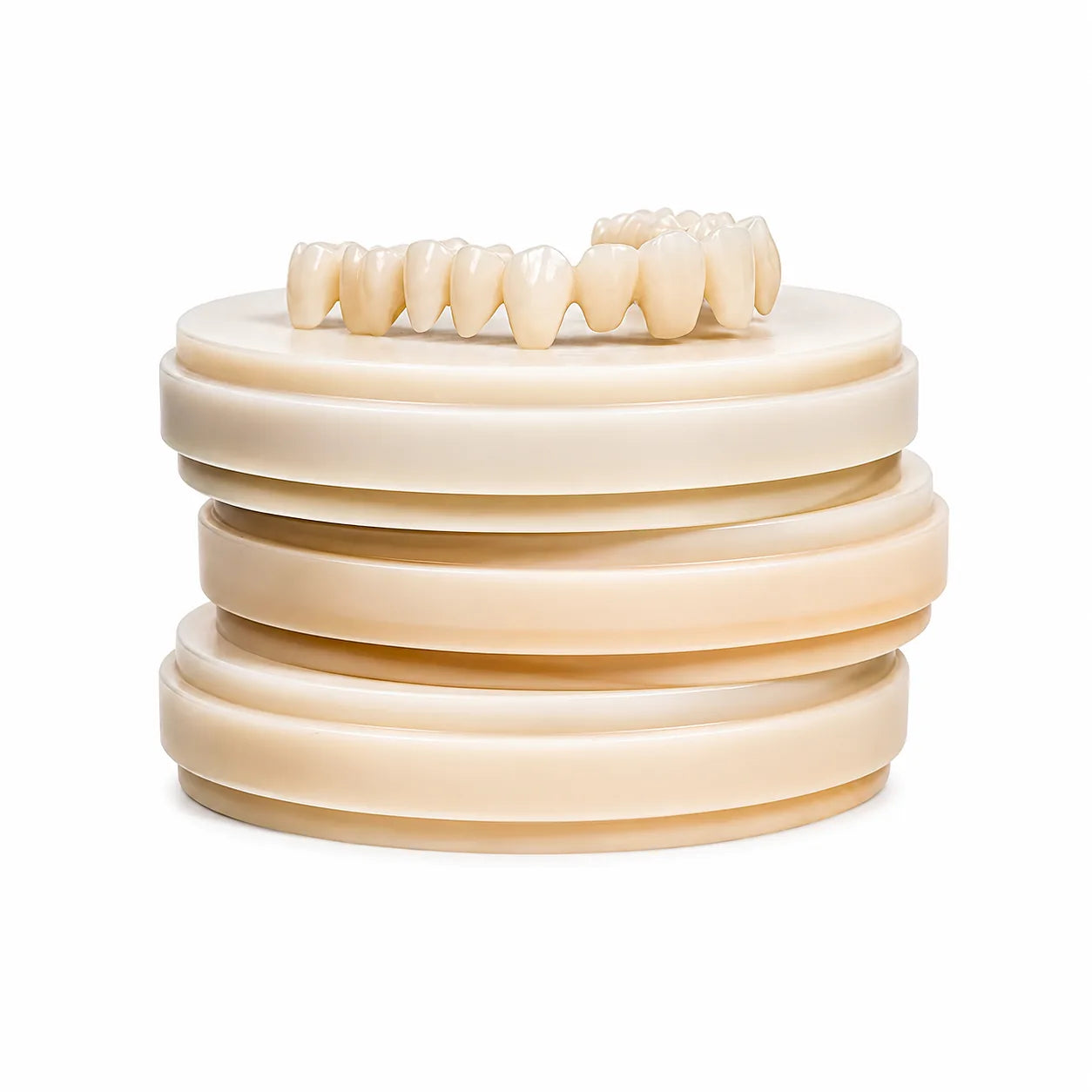
Stacked multilayer PMMA discs with natural shade gradient dental restoration

Recommended Applications

Multilayer PMMA discs are designed for dental laboratories that require a more natural shade transition in temporary and provisional restorations.

The 5-layer structure makes them particularly suitable for cases where anterior esthetics, tooth-length shade development, and natural-looking characterization are more important than a uniform single shade.

  • Highly esthetic temporary crowns and bridges
  • Full-arch provisional restorations
  • Implant-supported temporary restorations
  • Anterior provisional restorations
  • Diagnostic try-ins and mock-up
  • Immediate-load provisional cases

Technical Specifications

Parameter Value
Material PMMA (Polymethyl Methacrylate)
Shade Structure 5-layer gradient
Flexural Strength ≥120 MPa
Elasticity Modulus >2200 MPa
Solubility ≤0.8 μg/mm³
Water Absorption ≤20 μg/mm³
Residual Monomer Content <1%
Available Shades 17 shades (16 VITA shades + BL), each with a 5-layer gradient
Available Thicknesses 12mm, 14mm, 16mm, 18mm, 20mm, 22mm, 25mm, 30mm
System Compatibility 98mm Open System / 95mm Zirkonzahn
Processing Method CAD/CAM milling
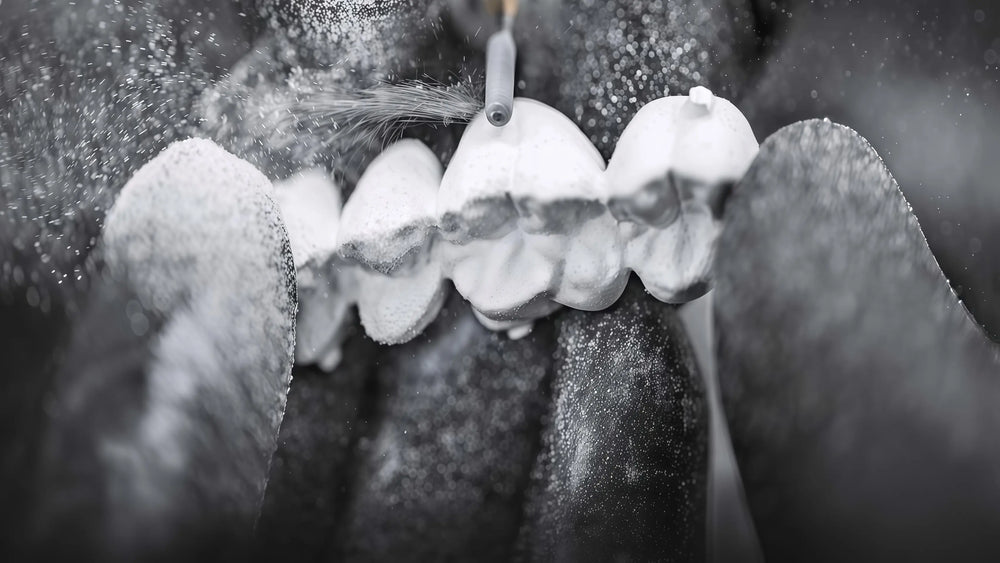
Multilayer PMMA temporary restorations during CAD/CAM dental milling

Recommended Milling Workflow

  1. Select the correct system, shade, and thickness
  2. Identify the cervical and incisal sides of the disc before nesting.
  3. Position the restoration vertically within the disc according to the desired cervical-to-incisal shade transition.
  4. Design the temporary restoration in CAD software
  5. Mill with PMMA-compatible burs and a suitable milling strategy
  6. Remove connectors and finish margins carefully
  7. Finish and polish progressively to achieve a smooth surface
  8. Verify fit, occlusion, shade transition, and surface finish before delivery

Multilayer PMMA vs. Monolayer PMMA

Compare PMMA options by shade structure, milling orientation, esthetic requirements, and case type.

  • Multilayer PMMA

    • Natural 5-layer shade gradient
    • Correct milling orientation required
    • Best for anterior, full-arch, and highly esthetic provisionals
  • Monolayer PMMA

    • Uniform single-shade structure
    • No milling orientation required
    • Best for strength, consistency, and cost-efficient temporary cases

What is Multilayer PMMA?

Multilayer PMMA is a CAD/CAM polymer disc with multiple integrated shade layers that create a gradual transition from cervical to incisal areas. It is designed for more natural-looking temporary and provisional restorations.

What restorations can Multilayer PMMA Discs be used for?

They are suitable for temporary crowns, bridges, full-arch provisionals, implant-supported temporary restorations, diagnostic try-ins, mock-ups, and highly esthetic anterior provisional cases.

How is Multilayer PMMA different from Monolayer PMMA?

Multilayer PMMA features a natural shade gradient and requires correct milling orientation. Monolayer PMMA has one uniform shade, offers simpler nesting, and is often selected for everyday temporary cases where cost efficiency and consistency are the priority.

Does milling orientation matter for Multilayer PMMA?

Yes. The cervical and incisal sides must be identified before nesting. Correct vertical positioning helps achieve the intended shade transition in the final restoration.

How should a restoration be positioned inside the disc?

Position the cervical area toward the darker layer and the incisal area toward the lighter or more translucent layer. The exact nesting position should be adjusted according to restoration height and the desired esthetic result.

Does Multilayer PMMA require sintering or crystallization?

No. Multilayer PMMA is milled directly and does not require sintering or crystallization. After milling, the restoration can be finished and polished.

What burs are recommended for milling Multilayer PMMA?

Use sharp PMMA-compatible burs and a milling strategy designed for resin materials. Worn burs may increase heat, surface roughness, and chipping around thin margins.

How many restorations can be milled from one Multilayer PMMA disc?

The number of restorations depends on the disc thickness, restoration size, nesting strategy, and spacing between units. A 98mm disc can typically accommodate multiple single units or several bridge and full-arch cases, depending on the design.

Explore More PMMA Disc Options

  • Monolayer PMMA

    Uniform-shade PMMA for temporary crowns, bridges, diagnostic try-ins, and cost-efficient provisional restorations.

  • Clear PMMA

    Transparent PMMA for splints, night guards, surgical guides, diagnostic try-ins, and other clear dental applications.

  • Pink PMMA

    Gingival-colored PMMA for denture bases, hybrid prosthetics, removable restorations, and everyday laboratory workflows.

1 of 3

Need Help Choosing the Right PMMA Disc?

Tell us your milling system, shade, thickness, and case type. Our team will help you choose the suitable PMMA disc for your dental lab workflow.