Skip to product information
1 of 2

OnePro Dental PEEK Discs-Yellow color

OnePro Dental PEEK Discs-Yellow color

Regular price $55.00
Regular price $70.00 Sale price $55.00
Sale Sold out
Shipping calculated at checkout.
System
Thickness
Color
Quantity

    Yellow PEEK Discs - Biocompatible High-Performance Polymer for Dental Implant Frameworks

    The Yellow PEEK Discs from OnePro Dental are engineered from PEEK (Polyetheretherketone), a high-performance thermoplastic polymer specifically designed for demanding dental applications. With an elastic modulus (3-4 GPa) close to natural bone, PEEK eliminates stress shielding effects common with metal implants, making it the ideal material for implant frameworks, temporary abutments, and long-term provisional restorations.

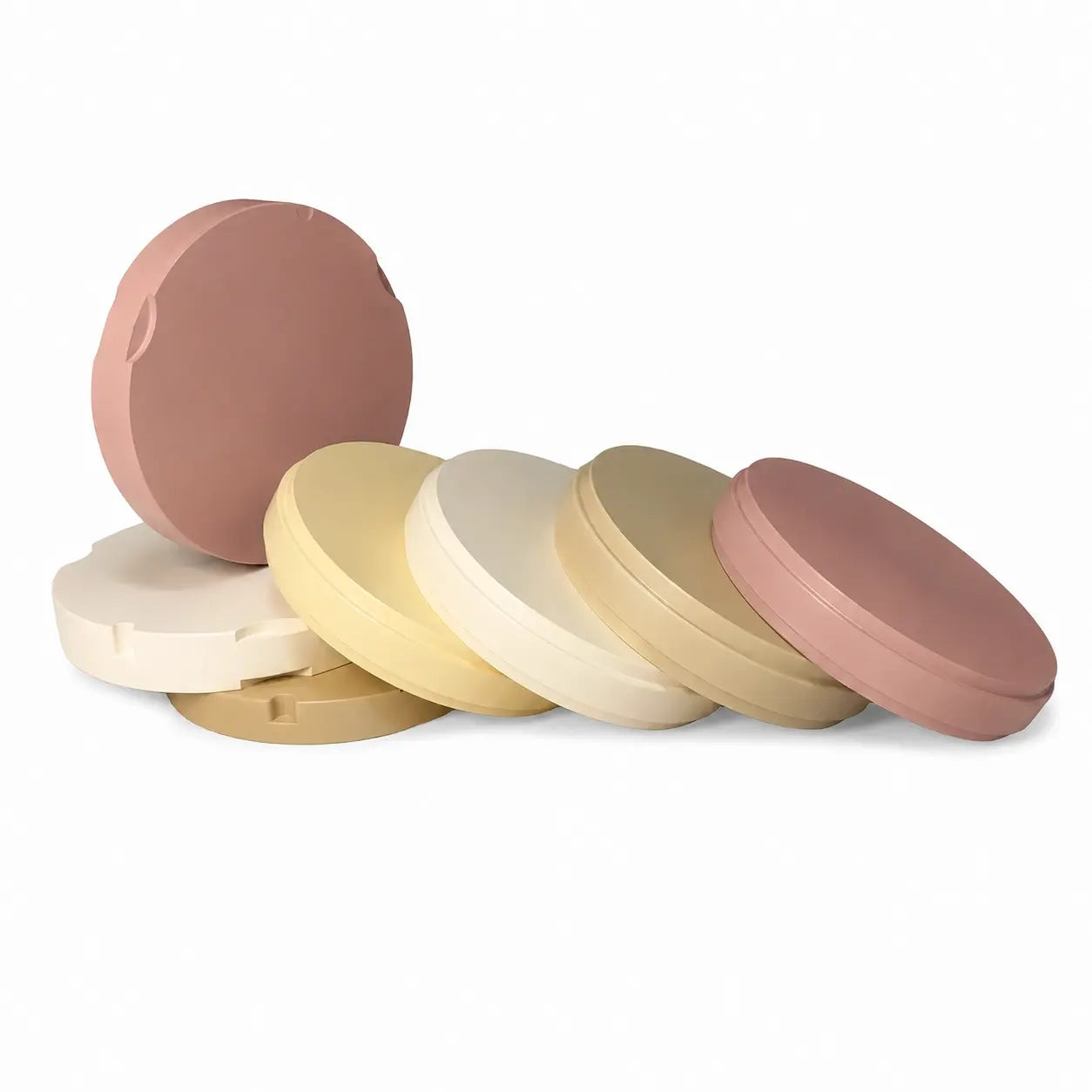
    Available in two system formats (98mm Open System, 95mm Zirkonzahn) and 7 thickness options (12-25mm), these yellow PEEK discs provide optimal versatility for all biocompatible dental prosthetic needs.

    Key Features:

    • High-Performance PEEK Material
      Medical-grade Polyetheretherketone with exceptional biocompatibility and mechanical properties.
    • Elastic Modulus Close to Bone (3-4 GPa)
      Reduces stress shielding effect - bone-like flexibility prevents bone resorption around implants.
    • Superior Biocompatibility
      ISO 10993 certified, hypoallergenic, and excellent tissue compatibility. No allergic reactions.
    • MRI Compatible
      Non-metallic material - fully compatible with MRI examinations without artifacts or safety concerns.
    • Lightweight Construction
      Density of only 1.3 g/cm³ - approximately 70% lighter than titanium for enhanced patient comfort.
    • Excellent Wear Resistance
      Superior abrasion resistance and long-term durability in the oral environment.
    • Yellow Color for Easy Identification
      Distinctive yellow color facilitates quality control and differentiation during fabrication.
    • Dual System Compatibility
      Available in 98mm Open System and 95mm Zirkonzahn formats for universal CAD/CAM compatibility.

    Recommended Indications:

    The Yellow PEEK Discs are recommended for:

    • Implant-supported frameworks - screw-retained or cement-retained frameworks on dental implants
    • Temporary implant abutments - long-term provisional abutments during healing periods
    • Implant bars - overdenture bars and hybrid prosthetic frameworks
    • Removable partial denture frameworks - lightweight, biocompatible, metal-free frameworks
    • Long-term provisional restorations - extended temporary crowns and bridges
    • Custom implant components - patient-specific implant superstructures
    • Orthodontic appliances - biocompatible retainers and functional appliances

    Yellow PEEK disc for implant-supported frameworks and temporary abutments - biocompatible, elastic modulus 3-4 GPaUnderstanding PEEK for Dental Applications:

    What is PEEK (Polyetheretherketone)?

    PEEK is a high-performance thermoplastic polymer belonging to the polyaryletherketone (PAEK) family. It was originally developed for aerospace and medical implant applications due to its exceptional combination of mechanical properties, biocompatibility, and chemical resistance.

    Why PEEK is Revolutionary for Dental Implantology:

    • Bone-Like Elastic Modulus: PEEK's elastic modulus (3-4 GPa) is much closer to bone (10-30 GPa) than titanium (110 GPa), reducing stress shielding
    • Stress Shielding Prevention: Flexible material allows natural stress distribution to the surrounding bone, preventing bone resorption
    • Superior Biocompatibility: ISO 10993 certified with excellent tissue integration and no allergic reactions
    • MRI Safety: Non-metallic composition allows safe MRI examinations without artifacts
    • Long-Term Stability: Proven clinical success in orthopedic and dental applications over decades

    The Stress Shielding Problem - Why PEEK Matters

    Traditional titanium implants and frameworks have a major limitation: their high elastic modulus (110 GPa) is much stiffer than bone (10-30 GPa). This stiffness mismatch causes stress shielding - the metal bears most of the load, reducing stress on surrounding bone. Over time, this can lead to bone resorption and implant failure.

    PEEK's Solution:

    • Elastic modulus (3-4 GPa) closer to bone allows natural stress distribution
    • Bone receives appropriate mechanical stimulation to maintain density
    • Reduces risk of peri-implant bone loss
    • Improves long-term implant success rates

    Technical Specifications:

    Property Yellow PEEK Titanium (for comparison)
    Material Type Polyetheretherketone (PEEK) Metal (Ti Grade 2/5)
    Elastic Modulus 3-4 GPa (bone-like) 110 GPa (very stiff)
    Tensile Strength 90-100 MPa 550-1050 MPa
    Flexural Strength 150-170 MPa 800-1200 MPa
    Density 1.3 g/cm³ (lightweight) 4.5 g/cm³ (heavy)
    Biocompatibility Excellent (ISO 10993) Excellent
    Stress Shielding Minimal (bone-like modulus) Significant (too stiff)
    MRI Compatibility Fully Compatible (no artifacts) Compatible (minimal artifacts)
    Wear Resistance Excellent Good
    Chemical Resistance Excellent Very Good
    Color Yellow (easy identification) Metallic gray
    Best For Implant frameworks, provisional Permanent implant restorations


    CAD/CAM Milling & Processing Workflow:

    Step 1: CAD Design & Milling Preparation (20-30 minutes)

    • Design implant framework or restoration in CAD software (3Shape, Exocad, DWOS)
    • Design with appropriate framework thickness (minimum 1.5-2.0mm for PEEK)
    • Verify screw access channels for implant-supported restorations
    • No enlargement factor needed - PEEK does not shrink during processing
    • Export STL file with correct orientation for milling
    • Select PEEK-specific milling program in the CAM software

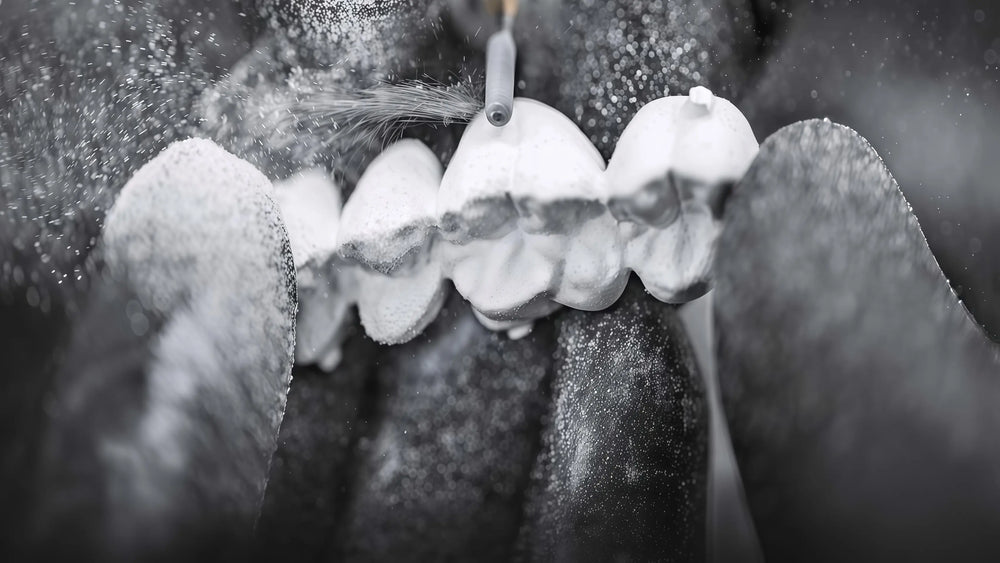
    Step 2: PEEK Milling (30-60 minutes) - Demanding Process

    • Recommended Parameters:
    • • Bur type: Carbide burs specifically designed for PEEK (TiAlN coated recommended)
    • • Bur size: 0.5-2.0mm diameter depending on detail level
    • • Spindle speed: 12,000-25,000 RPM (lower than PMMA, similar to titanium)
    • • Feed rate: 0.8-1.5 mm/s (slower than PMMA - PEEK is tough)
    • • Cooling: Wet milling mandatory - PEEK generates significant heat
    • • Milling strategy: Climb milling preferred to reduce tool wear
    • Important: PEEK is significantly tougher than PMMA - expect longer milling times and higher tool wear
    • Use fresh, sharp burs - dull burs cause excessive heat and poor surface finish
    • Monitor coolant flow continuously - inadequate cooling damages both material and tools

    Step 3: Surface Treatment & Finishing (20-30 minutes)

    • Mechanical Finishing:
    • • Remove milling tabs with carbide burs or diamond discs
    • • Smooth surfaces with PEEK-specific polishing burs
    • • Use progressive grits: coarse → medium → fine
    • • Achieve smooth surface to reduce plaque accumulation
    • Surface Treatment Options:
    • Sandblasting: 50-110 micron Al₂O₃ at 2-4 bar for roughened surface (bonding)
    • Plasma treatment: Atmospheric plasma for enhanced surface activation
    • Acid etching: Sulfuric acid treatment for improved bonding (optional)
    • Polishing: High-gloss finish for supragingival surfaces
    • Clean thoroughly with ultrasonic cleaner and steam

    Step 4: Quality Control & Delivery (10-15 minutes)

    • Verify fit on model or analog
    • Check screw access channels (for implant restorations)
    • Inspect surface finish and margins
    • Verify no sharp edges or rough areas
    • Clean and sterilize if required
    • Package in protective container

    ⚠️ Critical Milling Considerations for PEEK: PEEK milling requires specialized equipment and parameters. The material's toughness and low thermal conductivity make it challenging to machine. Always use PEEK-specific carbide burs, maintain adequate wet cooling, and expect 2-3x longer milling times compared to PMMA. Proper parameters prevent tool breakage and ensure quality results.

    Why Choose Yellow PEEK?

    Yellow PEEK Specific Advantages:

    The yellow color of these PEEK discs provides specific benefits:

    • Easy Identification: Distinctive yellow color facilitates quick identification during fabrication and quality control
    • Quality Control: Yellow color makes it easy to distinguish from other materials (white PEEK, natural PEEK, PMMA)
    • Visibility: Enhanced visibility during milling and finishing processes
    • Industry Standard: Yellow is a recognized color for certain PEEK applications in medical and dental fields
    • Differentiation: Helps labs organize and manage multiple PEEK material types

    PEEK vs Other Dental Materials

    Feature PEEK Titanium Zirconia
    Elastic Modulus 3-4 GPa (bone-like) 110 GPa (very stiff) 210 GPa (extremely stiff)
    Stress Shielding Minimal Significant Very Significant
    Biocompatibility Excellent (ISO 10993) Excellent Excellent
    MRI Compatibility Fully Compatible (no artifacts) Compatible (minimal artifacts) Fully Compatible
    Weight (Density) 1.3 g/cm³ (very light) 4.5 g/cm³ (moderate) 6.0 g/cm³ (heavy)
    Strength 90-100 MPa (moderate) 550-1050 MPa (high) 900-1200 MPa (very high)
    Wear Resistance Excellent Good Excellent
    Milling Difficulty Moderate-High Very High Moderate (requires sintering)
    Best For Implant frameworks, provisional Permanent implant restorations Permanent crowns & bridges

    Recommendation: Choose PEEK for implant frameworks requiring bone-like flexibility and minimal stress shielding. Choose Titanium for permanent implant restorations requiring maximum strength. Choose Zirconia for permanent esthetic crowns and bridges.

    Designed for Dental Laboratories

    OnePro Dental works directly with dental laboratories worldwide, providing reliable CAD/CAM materials that combine performance, consistency, and cost efficiency.

    The Yellow PEEK Discs are an excellent choice for labs seeking biocompatible, bone-like materials for implant frameworks and provisional restorations.

    Frequently Asked Questions (FAQ)

    💎 Product Features & Material Properties

    Q: What makes PEEK different from titanium for dental implant applications?
    A: PEEK's key advantage is its elastic modulus (3-4 GPa) close to natural bone (10-30 GPa), compared to titanium's 110 GPa. This bone-like flexibility reduces stress shielding - the phenomenon where stiff metal implants bear most of the load, causing bone resorption. PEEK allows natural stress distribution to surrounding bone, maintaining bone density and improving long-term implant success. Additionally, PEEK is 70% lighter than titanium, fully MRI compatible with no artifacts, and hypoallergenic.

    Q: What is stress shielding and why does it matter?
    A: Stress shielding occurs when an implant material is much stiffer than bone. The stiff material (like titanium or zirconia) bears most of the mechanical load, reducing stress on surrounding bone. Bone needs mechanical stimulation to maintain density - without it, bone resorbs (loses density) around the implant, potentially leading to implant failure. PEEK's bone-like elastic modulus (3-4 GPa) allows appropriate stress transfer to bone, preventing this problem.

    Q: Is PEEK biocompatible and safe for long-term use?
    A: Yes! PEEK is ISO 10993 certified for biocompatibility and has been successfully used in orthopedic and spinal implants for over 30 years. It's hypoallergenic with no known allergic reactions, and chemically inert in the oral environment. PEEK has proven long-term clinical success in dental applications, including implant frameworks, temporary abutments, and removable prosthetics.

    Q: Why choose yellow PEEK instead of white or natural PEEK?
    A: Yellow PEEK offers the same mechanical and biological properties as white or natural PEEK, but provides specific advantages: easy identification during fabrication and quality control, enhanced visibility during milling and finishing, helps labs organize and manage multiple PEEK material types, and is an industry-standard color for certain medical/dental PEEK applications. The color choice is primarily for workflow efficiency and quality control.

    🔧 Milling & Processing

    Q: Which CAD/CAM systems are compatible with PEEK discs?
    A: Yellow PEEK Discs are available in two formats: 98mm Open System (compatible with Roland, VHF, Amann Girrbach, Sirona, Yenadent) and 95mm Zirkonzahn (for Zirkonzahn systems). Both require professional 5-axis CAD/CAM milling systems with adequate spindle power for PEEK processing. Verify your system supports PEEK milling before purchasing.

    Q: What milling parameters should I use for PEEK?
    A: Recommended parameters for PEEK:
    Bur type: Carbide burs with TiAlN coating (PEEK-specific)
    Bur size: 0.5-2.0mm diameter
    Spindle speed: 12,000-25,000 RPM (lower than PMMA)
    Feed rate: 0.8-1.5 mm/s (slower than PMMA - PEEK is tough)
    Cooling: Wet milling mandatory - use abundant coolant
    Strategy: Climb milling preferred
    Important: PEEK is tougher than PMMA and generates significant heat - inadequate cooling damages both material and tools.

    Q: Why does PEEK milling take longer than PMMA?
    A: PEEK is significantly tougher and more heat-resistant than PMMA, requiring slower feed rates, more conservative cutting parameters, and more frequent tool changes. Expect milling times 2-3x longer than PMMA for similar geometries. However, PEEK's superior mechanical properties and biocompatibility justify the additional processing time for implant applications.

    Q: How often should I replace PEEK milling burs?
    A: PEEK causes higher tool wear than PMMA. Typical bur life:
    Roughing burs: 3-5 restorations
    Finishing burs: 5-8 restorations
    Replace burs when you notice: increased milling time (>20%), poor surface finish, excessive vibration, or visible wear on cutting edges. Using dull burs generates excessive heat and compromises quality.

    🦴 Clinical Applications

    Q: What are the best applications for PEEK?
    A: PEEK excels in applications requiring bone-like flexibility and biocompatibility:
    Implant-supported frameworks: Screw-retained or cement-retained frameworks on dental implants
    Temporary implant abutments: Long-term provisional abutments during healing
    Implant bars: Overdenture bars and hybrid prosthetic frameworks
    Removable partial denture frameworks: Lightweight, biocompatible metal-free frameworks
    Long-term provisional restorations: Extended temporary crowns and bridges
    PEEK is specifically recommended when stress shielding prevention and bone preservation are priorities.

    Q: Can PEEK be used for permanent restorations?
    A: PEEK is primarily used for long-term provisional and semi-permanent restorations rather than final permanent restorations. While PEEK has excellent biocompatibility and durability, its moderate strength (90-100 MPa) makes it less suitable for high-stress permanent applications compared to titanium (550-1050 MPa) or zirconia (900-1200 MPa). PEEK is ideal for implant frameworks, temporary abutments, and situations where bone-like flexibility is more important than maximum strength.

    Q: Should I choose PEEK or titanium for implant frameworks?
    A: Choose based on clinical priorities:
    Choose PEEK when:
    • Stress shielding prevention is critical (bone preservation)
    • Bone-like flexibility desired (elastic modulus 3-4 GPa)
    • MRI compatibility important (no artifacts)
    • Lightweight construction preferred (70% lighter than titanium)
    • Long-term provisional or semi-permanent restoration

    Choose Titanium when:
    • Maximum strength required (550-1050 MPa)
    • Permanent restoration needed
    • High occlusal forces present
    • Osseointegration critical (direct bone contact)

    For most implant frameworks, PEEK's stress shielding provides significant long-term benefits.

    🔬 Surface Treatment & Bonding

    Q: How do I bond or cement restorations to PEEK?
    A: PEEK requires special bonding protocols for optimal adhesion:
    Surface treatment options:
    • Sandblast with 50-110 micron Al₂O₃ at 2-4 bar
    • Atmospheric plasma treatment for surface activation
    • Sulfuric acid etching (optional, for enhanced bonding)

    Bonding:
    • Use PEEK-specific primers or universal adhesives
    • Resin cement or composite for bonding
    • MDP-based adhesives show good bond strength

    For screw-retained restorations:
    • No cementation needed - mechanical retention via screws
    • Preferred method for implant-supported frameworks

    Q: What surface treatments are recommended for PEEK?
    A: Surface treatment depends on application:
    For bonding surfaces:
    Sandblasting: 50-110 micron Al₂O₃ creates micro-roughness
    Plasma treatment: Atmospheric plasma for enhanced surface activation
    Acid etching: Sulfuric acid treatment (optional)

    For supragingival surfaces:
    Polishing: High-gloss finish reduces plaque accumulation
    • Use PEEK-specific polishing compounds

    Proper surface treatment is critical for achieving adequate bond strength to PEEK.

    📦 Ordering & Specifications

    Q: How many restorations can I get from one disc?
    A: Typical yield from a 20mm disc:
    Implant frameworks: 2-4 frameworks
    Temporary abutments: 8-12 abutments
    Partial denture frameworks: 1-2 frameworks
    Single crowns: 6-10 crowns

    Actual yield depends on restoration size, design complexity, and nesting efficiency.

    Q: Do you offer sample discs for testing?
    A: Yes! We offer sample discs for qualified dental laboratories. Contact our sales team at oneprodental@gmail.com to request samples and test the milling quality and material properties firsthand.

    Q: What is your shipping time?
    A: We offer fast global shipping with delivery in 5-10 business days. Express shipping options are available for urgent orders. Free shipping on orders over $500!

    🛠️ Technical Support

    Q: What if I need help with PEEK milling parameters?
    A: Our technical support team specializes in PEEK processing! We provide assistance with:
    • Milling parameter optimization for your specific machine
    • Tool selection and bur recommendations
    • Surface treatment protocols
    • Troubleshooting milling issues
    • CAM programming guidance

    💬 Still have questions? Contact our expert team at oneprodental@gmail.com or use the live chat feature. We're committed to your success with every PEEK restoration!

    🦴 Ready for Bone-Like Flexibility?

    Join hundreds of dental laboratories worldwide who trust OnePro Yellow PEEK for implant frameworks and biocompatible restorations

    ✨ Yellow PEEK Advantages:

    • Elastic Modulus 3-4 GPa - Bone-like flexibility prevents stress shielding
    • ISO 10993 Biocompatible - Excellent tissue compatibility, hypoallergenic
    • MRI Fully Compatible - Non-metallic, no artifacts or safety concerns
    • 70% Lighter than Titanium - Enhanced patient comfort (1.3 g/cm³)
    • Excellent Wear Resistance - Long-term durability in the oral environment
    • Yellow Color Identification - Easy quality control and differentiation
    • Dual System Formats - 98mm Open System & 95mm Zirkonzahn

    💰 High-Performance PEEK: $55-$85 per Disc

    7 thickness options (12-25mm) - Perfect for implant frameworks & provisional restorations

    🚀 Order Today & Get:

    📋 Complete PEEK Milling Parameter Guide

    🔧 Surface Treatment Protocol Document

    💬 Priority Technical Support Access

    🎬 Video Tutorial: PEEK CAD/CAM Workflow

    Perfect For:

    🦷 Implant Frameworks

    Screw-retained & cement-retained

    🔩 Temporary Abutments

    Long-term provisional solutions

    🌉 Implant Bars

    Overdenture & hybrid frameworks

    "Trusted by dental laboratories in over 50 countries worldwide."

    🔒 Secure Checkout | 📦 Free Shipping Over $500 | 💯 Quality Guaranteed

    OnePro Dental - Empowering dental laboratories with high-performance PEEK solutions since 2018

    View full details

    Customer Reviews

    0 out of 5 Based on 0 reviews Collected by EasyReviews
     
    0
     
    0
     
    0
     
    0
     
    0

    Write a review